Setup: your repo and your agent
- Block
- Setup: during the talk
- Outcome
- Your own repo, live on the web, and the Antigravity CLI started in it, ready for the Analyst
- Time box
- About 3 minutes after the prep; about 15 without it
Click Next when a step works. Stuck? Click Stuck? at the top. Everything the talk says is in this guide too, under After the workshop, so you can read it later.
Did you do the prep? 0:10 min
The prep page sets up your laptop at home: a personal Google account, a GitHub account, the tools and both sign-ins, and your content for the Analyst. Its last step says That's all.
Not sure? Choose No: the steps check everything, and the line only does what is still missing.
A Google and a GitHub account 5:30 min
The agent's AI runs on the free weekly quota of a Google account, and GitHub holds and publishes your site.
- Google: a personal account, for example a Gmail address. A work or school account may be blocked. None yet? Create one at accounts.google.com/signup; Google checks your email address and your phone with a code.
- GitHub: none yet? Open github.com/signup and click Continue with Google, with the Google account from the line above. Choose your username with care: it becomes part of your site's address,
https://YOUR-USERNAME.github.io/YOUR-REPO/.
You know it worked when github.com shows your profile picture in the top right corner.
Run the line for today's workshop 5:00 min
The Install script installs what your agents need where it is missing: Git, Node, the GitHub CLI and the Antigravity CLI. After one sign-in to GitHub it makes your own repo from the Template repo, puts it on the web with GitHub Pages, copies it into a folder of the same name, YOUR-REPO, in your home folder, and starts the Antigravity CLI there.
Did the prep? Then the tools are there and you are signed in: the line only makes your repo, in about a minute. Is the Antigravity CLI still open from home? Type /exit and press Enter first.
Your new repo is called portfolio. You already have a repo of that name on GitHub, such as a site of your own? Then type another name here first, such as portfolio-2026, and click Save: the line below makes your new repo under that name. Your old repo and its site stay as they are.
Open a terminal (the window where you type commands), paste the line for your system and press Enter. Type nothing else: the line does the work. It is longer than the one on the prep page, because it makes your repo for today's workshop: use this one.
The guide opened the tab for your system. Check that it is yours.
Open Terminal: press Cmd+Space, type Terminal and press Enter. Paste with Cmd+V.
curl -fsSL https://raw.githubusercontent.com/fabkrum/portfolio-template/main/install.sh | WORKSHOP_EVENT="DevFest Milano 2026" WORKSHOP_DATE=2026-10-10 WORKSHOP_CITY="Milan" WORKSHOP_START="" WORKSHOP_END="" shA window asks you to install the command line developer tools (Apple's package that brings Git)? Click Install, not "Get Xcode". When it is done, after five minutes or more on busy Wi-Fi, run the same line again.
Open PowerShell: click Start, type PowerShell and open Windows PowerShell, not as administrator. Paste with Ctrl+V or a right-click.
$env:WORKSHOP_EVENT="DevFest Milano 2026"; $env:WORKSHOP_DATE="2026-10-10"; $env:WORKSHOP_CITY="Milan"; $env:WORKSHOP_START=""; $env:WORKSHOP_END=""; irm https://raw.githubusercontent.com/fabkrum/portfolio-template/main/install.ps1 | iexWindows asks whether to allow an installer to make changes? Click Yes.
Open Terminal: on Ubuntu press Ctrl+Alt+T, or find Terminal in your app menu. Paste with Ctrl+Shift+V.
wget -qO- https://raw.githubusercontent.com/fabkrum/portfolio-template/main/install.sh | WORKSHOP_EVENT="DevFest Milano 2026" WORKSHOP_DATE=2026-10-10 WORKSHOP_CITY="Milan" WORKSHOP_START="" WORKSHOP_END="" shIt asks for your password? Type the one you use to log in to your laptop, and press Enter. Nothing appears while you type.
Only if it answers wget: command not found: use this line instead. It runs the same script.
curl -fsSL https://raw.githubusercontent.com/fabkrum/portfolio-template/main/install.sh | WORKSHOP_EVENT="DevFest Milano 2026" WORKSHOP_DATE=2026-10-10 WORKSHOP_CITY="Milan" WORKSHOP_START="" WORKSHOP_END="" shNot signed in to GitHub yet? Then the script asks you to sign in, once:
- The terminal shows a code of eight characters, such as
ABCD-1234, and your browser opensgithub.com/login/device. The browser does not open? Openhttps://github.com/login/deviceyourself. - Type the code on that page and click Continue.
- On the next page, click Authorize. That lets the script make your repo and publish it. The page then says your device is connected, and the terminal goes on by itself.
- The script says You already have a repo called portfolio on GitHub and asks for a name for the new one? Your old repo stays as it is. Press Enter to take
portfolio-2026, or type another name. Then type the same name into the box Your repo's name above and click Save: this guide then shows your folder and your address with that name, and the line finds your repo next time without asking.
What you see on a Mac (example)
Setting up your laptop for the portfolio workshop.

Apps
  [ok]    Google Chrome is installed.

GitHub
  [ok]    The GitHub CLI is installed (gh 2.103.2).
          Now sign in to GitHub. Your browser opens github.com/login/device: ...
! One-time code (ABCD-1234) copied to clipboard
  [ok]    Signed in to GitHub as luca-bianchi.
  [ok]    Created your repo https://github.com/luca-bianchi/portfolio from the workshop's template.
  [ok]    GitHub Pages is on: your site goes live at https://luca-bianchi.github.io/portfolio/ a minute after each push.

Tools
  [ok]    Git is installed (git version 2.54.0 (Apple Git-157)).
  [ok]    Node is installed (v25.2.1).
  [ok]    Chrome DevTools for agents is ready.

Your repo
  [ok]    Copied your repo to /Users/luca-bianchi/portfolio.
  [ok]    Saved your workshop in workshop.json: DevFest Milano 2026.
  [ok]    git push uses your GitHub sign-in.

Antigravity CLI
  [ok]    Installed the Antigravity CLI (agy 1.4.7).
  [ok]    The Antigravity CLI starts in auto mode, with Gemini 3.8 Flash, the workshop's model.
          When the Antigravity CLI starts, it asks you to sign in with your Google account, in the browser.

Summary
Everything is ready.
Run this command again any time; it only does what is still missing.

Starting the Antigravity CLI in your repo folder.
You know it worked when the summary says Everything is ready. and the Antigravity CLI starts.
After the prep, the Antigravity CLI starts signed in: go on to Talk to your agent. Without the prep, it asks you to sign in: that is the next step.
The summary says Still to do? Do each numbered item, then paste the same line again: it only does what is still missing. It says to open a new terminal window? Close this one, open a new one and paste the line there. Stuck? has the usual problems.
Sign in to the Antigravity CLI 2:00 min
The first time it starts, the Antigravity CLI asks four things. Use the arrow keys and Enter:
- Select login method: keep Google OAuth and press Enter.
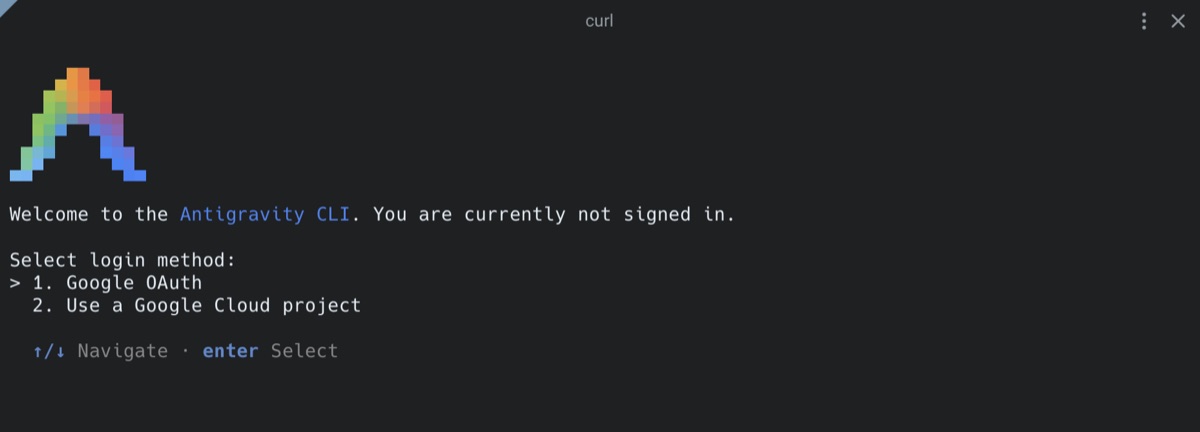
The first start: Google OAuth is already selected. - Your browser opens Google's sign-in: sign in with your personal Google account. The browser does not open? The terminal shows a link: copy it into your browser.
- The browser page shows a code and asks you to paste it into your application? Click Copy to Clipboard. Then click into the terminal, paste, and press Enter.
- Terms of Service & Data Use: the box is optional, and Enter ticks it. Press ↓ until Done is highlighted, then press Enter.
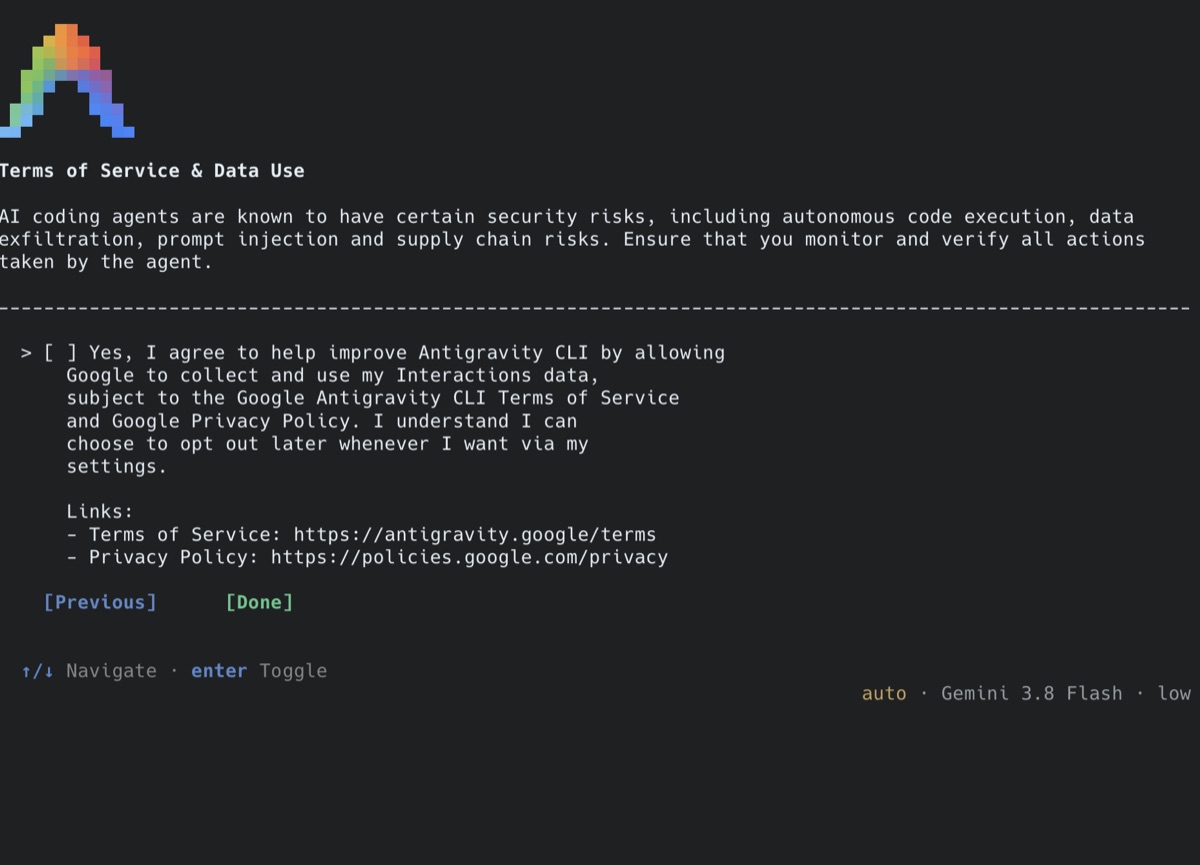
The box shares your interactions with Google to improve the CLI; the workshop works either way. - Choose your color scheme: press Enter for terminal, or pick another.
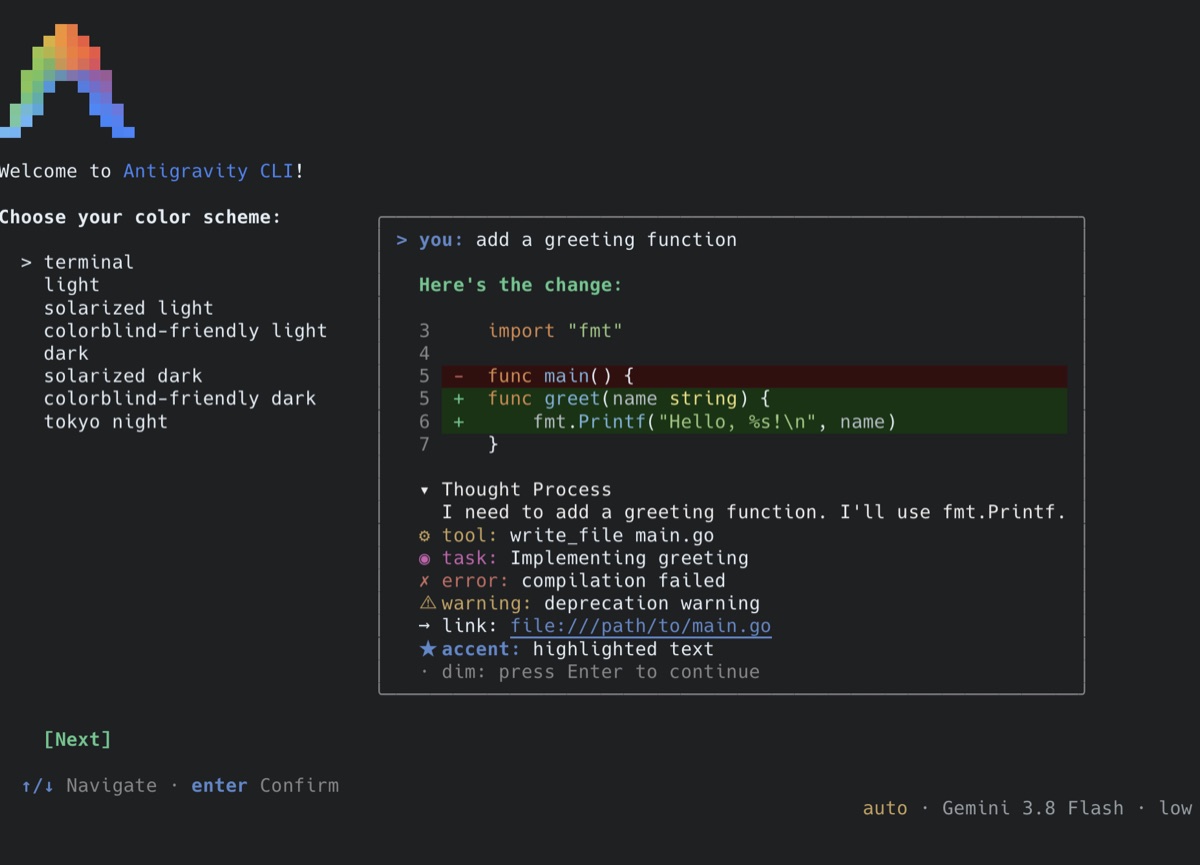
Any colour scheme works. The box on the right is only a preview of the colours, error line included.
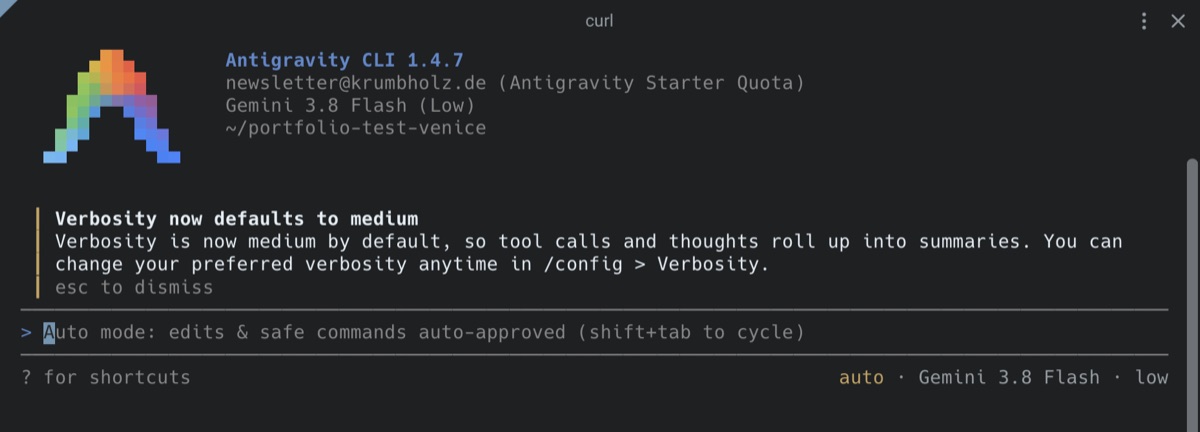
You know it worked when the Antigravity CLI shows your Google account, Gemini 3.8 Flash (Low) and your folder at the top, and its bottom line says auto · Gemini 3.8 Flash · low.
Talk to your agent 1:00 min
- Type and send: type into the line with > and press Enter.
- A file: drag it from your folder into the window. Its path appears in your message; press Enter.
- Between Roles: type
/clearand press Enter. It resets the context window, so the next Role starts in a fresh chat. - A question with numbered answers, such as "Allow this command?": pick Yes with the arrow keys and press Enter. No stops the whole step: then type
go on. - Done for today: type
/exitand press Enter. It closes the Antigravity CLI. - Come back later: open a terminal. Type
cd YOUR-REPOand press Enter. Then typeagyand press Enter.
Check that you are ready 1:00 min
Confirm each point
- The line ended with Everything is ready.
- The Antigravity CLI shows your personal Google account, and its bottom line says auto · Gemini 3.8 Flash · low.
- Your site shows Ada Example, the sample person, at
https://YOUR-USERNAME.github.io/YOUR-REPO/. The first time, GitHub needs a minute or two to publish it: reload the page. - Your content for the Analyst is ready: your CV or LinkedIn PDF, and your note. Not yet? Do step 4 of the prep page now.
One more thing: your GitHub username. Open github.com; it is the name in the menu under your profile picture. Type it here once; every address and command in this guide then carries it.
A point does not hold? Stuck? has the usual problems and what to do.
Stuck?
Copy the exact error message into Gemini and ask what to do. Once the Antigravity CLI runs, ask its agent instead: type Where am I? and press Enter. Still stuck? Ask your neighbour, or raise your hand. These are the usual problems:
GitHub says "Uh oh, we couldn't find anything" after the code
Cause: the code was mistyped, or it is older than 15 minutes.
Fix: open https://github.com/login/device again and type the code from the terminal, letter by letter. If the script has moved on, run the line again: it shows a new code.
"The sign-in to GitHub did not finish", then "What is your GitHub username?"
Cause: nobody clicked Authorize within five minutes, or your GitHub account does not allow the sign-in.
Fix: press Ctrl+C and run the line again. Still no luck? Make your repo by hand as in Your repo by hand, then run the line once more. When it asks for your username, paste your new repo's link from the browser's address bar, such as https://github.com/YOUR-USERNAME/YOUR-REPO, and press Enter.
"I could not find your repo at https://github.com/…"
Cause: you made the repo by hand, and the username or the repo's name in the message is not your repo's, or the repo is private.
Fix: open your repo on GitHub and compare its address with the one in the message.
- Another repo name? Type the name GitHub shows into the box Your repo's name in Run the line for today's workshop, click Save, and copy the line again. Or run the line and, when it asks, paste your repo's link from the browser's address bar.
- Private? In your repo, open Settings → General; at the bottom, under Danger Zone, click Change visibility and choose Public.
Then run the line again.
"You already have a repo called portfolio on GitHub, and it is not a copy of the workshop's template"
Cause: a repo of yours already has that name, such as a site you made before. The script leaves it as it is and asks for another name for the new one.
Fix: press Enter to take portfolio-2026, or type another name and press Enter. Then type the same name into the box Your repo's name in Run the line for today's workshop and click Save. Do not rename your old repo: its site would move to another address.
"No free name for your repo was found"
Cause: every name you gave already belongs to another repo of yours.
Fix: type a name you do not use on GitHub yet into the box Your repo's name in Run the line for today's workshop, such as portfolio-workshop, click Save, and copy the line again.
"That does not look like a GitHub username"
Cause: the script asked for your username, and got an email address, a full name or a typo.
Fix: run the line again. When it asks, type only your username, or paste your repo's link from the browser's address bar, such as https://github.com/YOUR-USERNAME/YOUR-REPO.
"… is not recognized as an internal or external command" on Windows
Cause: you are in Command Prompt, not PowerShell.
Fix: click Start, type PowerShell, open Windows PowerShell and paste the Windows line there.
"A parameter cannot be found that matches parameter name" or "'sh' is not recognized" on Windows
Cause: you pasted the Mac or the Linux line. They do not work on Windows.
Fix: open the Windows tab in Run the Install script and paste its line, the one that starts with $env:, into Windows PowerShell.
"command not found: wget" or "curl: command not found"
Cause: the line is for another system, or your system lacks the download tool it uses.
- Mac,
zsh: command not found: wget: that was the Linux line. Paste the one from the Mac tab. - Linux,
curl: command not found: that was the Mac line. Paste the one from the Linux tab. - Linux,
wget: command not found: your system lacks wget. Paste the second line in the Linux tab.
"command not found: agy", "command not found: node", or "… is not recognized"
Cause: this terminal window was open while the tool was installed.
Fix: close the terminal window and open a new one. Type cd YOUR-REPO and press Enter. Then type agy and press Enter.
An administrator password you do not have, or "Git could not be installed"
Cause: installing Git needs administrator rights. A work or school laptop often does not give them to you.
Fix: click No on Windows or Cancel on a Mac. The script downloads your repo without Git, and every Block works. If Git is the only to-do left, you are ready. At Ops you publish in the browser: see If something goes wrong on the Ops page.
"There is already a folder …, and it is not your portfolio repo"
Cause: your home folder already has a folder with your repo's name, YOUR-REPO, and something else is in it.
Fix: rename or move that old folder, for example to YOUR-REPO-old, then run the line again. Nothing in it is lost.
The Antigravity CLI does not let me sign in
Cause: usually a work or school account, the age check, your region, or a used-up quota.
Fix: type /logout, then sign in with a personal Google account. If that does not help, pair with your neighbour: see If the Antigravity CLI does not work for you.
My site shows "404" or nothing
Fix: wait a minute and reload. On a new GitHub account, the first publish can need as long as ten minutes. Check that Settings → Pages → Source says GitHub Actions and that the newest Deploy to GitHub Pages run in the Actions tab has a green tick.
Your repo by hand
Only if the GitHub sign-in in the Install script does not work for you. Do this in your browser, signed in to github.com.
- Open the Template repo. Click the green button Use this template, then Create a new repository.
- Repository name:
portfolio. GitHub says you already have a repository of that name? Take another, such asportfolio-2026, and type it into the box below. Choose Public, then click Create repository. - On your repo's page, click the tab Settings, then Pages in the menu on the left. Under Build and deployment, set Source to GitHub Actions.
- Click the tab Actions, then Deploy to GitHub Pages on the left, then Run workflow twice: the grey button, then the green one. Wait for the green tick.
Then run the line from Run the line for today's workshop again. When it asks What is your GitHub username?, paste your new repo's link from the browser's address bar, such as https://github.com/YOUR-USERNAME/YOUR-REPO, and press Enter.
If the Antigravity CLI does not work for you
You still leave with your own repo and your own live site: you follow the Roles on your neighbour's laptop, and one command per Block keeps your laptop in step with the room.
- Tell the Instructor.
- Run the Install script anyway, as in Run the Install script. It makes your repo and copies it into the folder
YOUR-REPOin your home folder. - Open a terminal in that folder. Open a fresh terminal: Terminal on a Mac and on Linux, Windows PowerShell on Windows. Paste this (Cmd+V on a Mac, Ctrl+V on Windows, Ctrl+Shift+V on Linux) and press Enter. It prints nothing; the line before the cursor now ends in
YOUR-REPO.
Terminal · same on Mac, Windows and Linux
cd YOUR-REPO- Sit with your neighbour. In every Block, follow the Role on their laptop: read each read-back with them and help them decide.
- In the Analyst Block, write your content by hand. Open
site/content.jsonin a plain text editor:
In Finder, press Cmd+Shift+H, then open YOUR-REPO and site. Right-click content.json, then Open With → TextEdit. In TextEdit, untick Edit → Substitutions → Smart Quotes, so your quotes stay straight.
In File Explorer, type %USERPROFILE%\YOUR-REPO\site into the address bar and press Enter. Right-click content.json, then Open with → Notepad.
In Files, open Home, then YOUR-REPO and site. Right-click content.json, then Open With → Text Editor.
Replace Ada Example's words between the quotes with yours, from your name down to your CV: her pitch, highlights, availability, city and languages too. Leave the words before each colon as they are, and keep mailto: in front of your email address. A project needs a link to its GitHub repo. No such project yet? Delete everything between the square brackets after "projects":, so the line reads "projects": []. Save the file, then check it:
Terminal · same on Mac, Windows and Linux
node tools/check-content.mjsIt names what to fix, such as a missing comma. Fix it, save, and run the check again until it says site/content.json is ready.
- Each time a Block's time is up, run the room's checkpoint on your own laptop, with the Block that has just ended. After the Analyst Block, that is:
Terminal · same on Mac, Windows and Linux
node tools/checkpoint.mjs analystAfter the next Blocks, replace analyst with designer, developer and qa. The Developer's checkpoint writes your legal page too.
- In the Ops Block, publish by hand. Paste these commands one at a time, press Enter after each, and read what it prints before the next.
See what would be published. Only files in site/, and maybe design/brief.md or docs/spec.md, belong in the list. Move anything else, such as a CV, out of the folder first:
Terminal · same on Mac, Windows and Linux
git statusAdd the changes:
git add -ASave them in a commit:
git commit -m "Publish my portfolio"Send the commit to GitHub. It uses the GitHub sign-in from the Install script, so it asks nothing:
git pushWait until your site is online:
node tools/live.mjsDone when it prints Your site is live, and your address shows your name.